Socially distant, but historically connected

Mother Nature may be the only entity unaware of the public health concerns we hear more about each day.

The sun continues to shine, and cherry blossom trees gave us their annual splendor, almost adding insult to the injury of having to call off our town’s prized Cherry Blossom Festival. But, as community organizations have kept us in the spirit with virtual programming, we are all discovering ways to stay connected with and supportive of our community.

Trent Mosely, Rachelle Wilson pause during a bike tour earlier this month.

Trent Mosely, Rachelle Wilson pause during a bike tour earlier this month.

One way to stay connected is by taking a tour of one of Macon’s historic districts and learning more about our historically rich community. Historic Macon’s website has amazing resources and guides, enabling you to take most of these tours virtually from the comfort and safety of home, on foot or by bike — or even by car.

Many of us have taken to neighborhood walks or bike rides these days, alone or with immediate family members and at a safe distance from others, to maintain healthy practices and get a glimpse of this gorgeous spring. Local advocacy organization Bike Walk Macon has compiled a list of local and national guidelines for walking or biking outdoors while complying to recommended safety practices for yourself and others. (As things change daily, please consult the most recent public advisory before leaving your house. )

Below we have compiled a list of resources for historic tours throughout Macon to experience whichever way you feel most comfortable. And here’s a video of our recent tour. Enjoy!
fullsizeoutput_12dc.jpeg

Music History Tour

virtual • bike • foot • car

In and around downtown, this tour is full of interesting facts and plenty of fun. Many of the sites are marked with plaques that denote a spot of significance. Click here for a map and to access the tour brochure and here for a playlist with some of the featured artists.

Cotton Avenue District  

virtual • bike • foot • car

During the 20th century, Jim Crow laws forced African-Americans to establish separate business districts in Macon. The Cotton Avenue District became one of these areas, and it grew into a major center of black business. Click here to access the tour brochure for this historically significant area folded into present-day downtown Macon.

Industrial District  

virtual • bike • foot • car

Now’s a great time to explore a neighborhood or historic district on bicycle.

Now’s a great time to explore a neighborhood or historic district on bicycle.

On the outskirts of downtown Macon in what was once known as the Tybee neighborhood, you can find the Industrial District. Click here for the tour brochure and insight into this surprisingly vast historical area.

Lights On Macon

virtual • bike • foot

A truly beautiful experience, Lights On Macon compiles a brief history of more than 150 historic houses in Macon. This is an experience that can be divided into neighborhoods and enjoyed over time or all at once.

Historic neighborhoods

bike • foot • car

From Ingleside to Cherokee Heights to Pleasant Hill and North Highlands, Macon has many historic neighborhoods with unique houses. To break up the monotony of days at home, consider driving through one of these historic districts and learning a bit about a neighborhood you may have never experienced before.

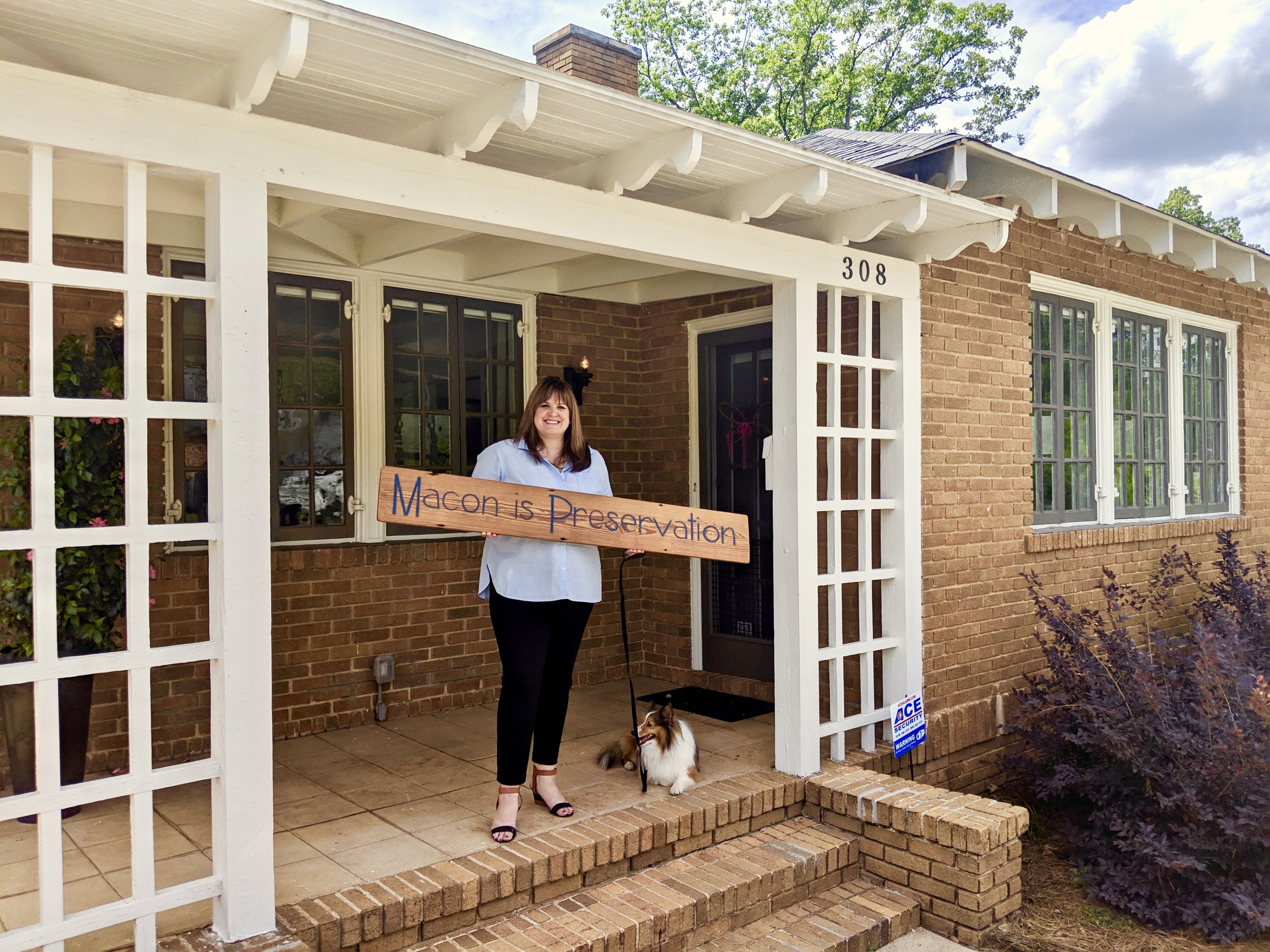
As you go on your historical journey, whether virtually or in person, be sure to share your experience by using #maconispreservation and tagging @historicmacon.

Ghosts of the past come rushing back

Social distancing — and disruption. The closing of schools, factories, small businesses and churches. Quarantines. Panic buying.

They’re all making the news these days, harkening back to the so-called “Spanish flu” pandemic of 1918.

An estimated 30,000 Georgians died from it. All told, about 675,000 Americans succumbed, most of them young adults 20 to 40 years old. Worldwide death estimates range from 50 million to 100 million — many of them soldiers, in trenches and barracks. 

An emergency hospital in Kansas during the 1918 influenza epidemic. (National Museum of Health and Medicine)

An emergency hospital in Kansas during the 1918 influenza epidemic. (National Museum of Health and Medicine)

Back then there were no vaccines, antibiotics, ventilators or electron microscopes. Health officials could not test people with mild symptoms so they could self-quarantine. There was little protective equipment for health-care workers. And it was almost impossible to trace contacts, since this particular strain of H1N1 flu seemed to engulf entire communities so quickly.

The outbreak came in waves. The first one hit that spring. The second, in the fall, was the most deadly. (Health officials are worried about that prospect now in the face of our current circumstances.)

In all, a half-billion people were infected — about a third of the world’s population at the time. One estimate says the virus infected up to a quarter of the American population of about 103 million people.

Safety guidelines from Illustrated Current News (National Library of Medicine)

Safety guidelines from Illustrated Current News (National Library of Medicine)

It was a silent foe for months. In the early days, many folks didn’t take it seriously. Back then, authorities “didn’t know what was happening, didn’t know what to do and, therefore, they did the human thing, which is to say it’s not happening,” Dr. Alfred Crosby says in his book “America’s Forgotten Pandemic.” Then people started dying.

In Georgia, the flu wave hit Camp Hancock near Augusta in early October. Recruits received physicals, then were sent off to crowded training camps for later deployment to Europe to fight in World War I. Military trains brought the virus to camps near Atlanta, Columbus and Macon — Camp Wheeler — before it spread to nearby cities. (And Camp Wheeler had just dealt with a measles epidemic the year before.)

Downtown Macon in the early 1900s.

Downtown Macon in the early 1900s.

“Today in Georgia History” pegs the date the virus descended on Macon as Oct. 15, 1918. “The Spanish influenza epidemic sweeping the nation hit Macon, with 250 new cases reported in the previous 48 hours.”  

Two huge forces were at cross-purposes that fall: continued soldier recruitment to fight (and the close quarters that effort entailed, from military trains to troopships), and the need for social distancing and shutting down activity to quell the virus’ spread.

It’s hard to believe, but the virus and its devastation weren’t often front-page news at the time, at least not in Macon. 

The major countries fighting in the war didn’t want to give their enemies any advantage, so the extent of the flu’s rampage — from both local and national leaders — was often minimized. There was wartime morale to consider. And officials wanted to preserve the public order and avoid panic.

Dispatches about the flu often ran on page 3 inside The Macon Daily Telegraph, said Joe Kovac Jr., a senior reporter for The Telegraph who looked at the paper’s coverage and tweeted about the outbreak recently:

“Our Spanish Flu coverage in Macon in October 1918 included an editorial on embracing inconveniences to avoid spread. (Wearing masks appears to have been encouraged: “A city of bandaged faces is better than coffins piled up in our morgues.”)

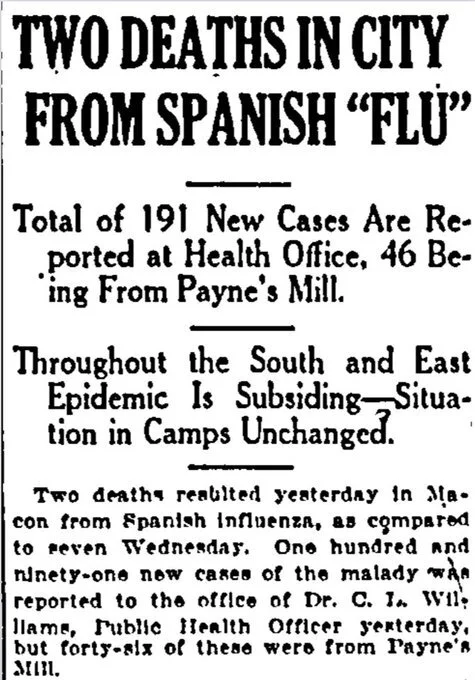
One subhead read: “Total of 191 New Cases Are Reported at Health Office, 46 Being from Payne’s Mill

Spanish flu update in The Macon Daily Telegraph.

Spanish flu update in The Macon Daily Telegraph.

From an editorial of the day titled “Flail the Flu,” which Kovac cited:

“If these men who have our community health in charge come to the decision all public gatherings should be closed they will act promptly and without fear because public sentiment is already strongly for that,” it read in part. “Fortunately it seems we are so far from the epidemic stage in Macon there is every hope it will not even threaten to reach that stage and that as it stands now it can be as well handled by people going pretty well as usual about their affairs provided they exercise due personal diligence in protecting both themselves and other people.”

As for our current challenge, we don’t know yet if the past is prologue, as Shakespeare told us. But we do know this: In this time of great uncertainty, what has gotten us through other national crises will serve us well now: Setting aside differences and pulling together. Helping each other however we can, from a video call to a grocery run for an older neighbor. Staying connected, through social media or across a backyard fence. Letting others know that they are not alone.

Stay safe and take care. And let us hear from you.

A Macon street bears his name, but you don’t know his story

You’d have to forgive Louis Persley if he had occasional bouts of identity crisis.

He was born in Macon in 1890 and died in 1932. You’ll find his first name spelled both “Lewis” and “Louis” in different registries. Census records from 1900, 1910 and 1920 spell his family’s last name “Pearsley,” “Parfley” and then “Persley.” There are even variations in his middle name (Hudson/Hudison).

A Macon street named for him (or his family) is spelled “Pursley,” and that’s how his name reads on his gravestone in Linwood Cemetery, where he is buried.

Louis Persley

Louis Persley

But make no mistake. There was never any confusion about his talent in his chosen field, architecture. And that was at a time when such an achievement was virtually unheard of for a person of color. In fact, the Macon native was the first registered black architect in Georgia. It happened 100 years ago, on April 5,  1920.

Still, few people have ever heard of Persley. One reason is that there’s not a lot of information out there about him.

“He’s still obscure in history,” said Muriel McDowel Jackson, the head genealogy librarian and archivist at Washington Memorial Library. “We have black history, but we don’t have all of black history. We’re still learning information about people.”

(Jackson also told us about Wallace A. Rayfield, who was born in Macon in 1874 and also went on to become an architect. He designed the famous 16th Street Baptist Church in Birmingham, Ala., that was bombed in 1963 during the civil rights movement.)

IMG_0448 copy.jpg

Persley grew up in the Pleasant Hill neighborhood, now a historic district. His mother and father, Maxie and Thomas, lived with their four sons at 215 Madison St., although it’s now 122 Madison St. thanks to a recalibration of street addresses decades ago. 

Persley attended public schools in Macon and then headed to Lincoln University, a historically black university near Oxford, Penn. He graduated from Carnegie Institute of Technology with an architecture degree in 1914.

Robert Robinson Taylor

Robert Robinson Taylor

Tuskegee Institute in Macon County, Alabama — now Tuskegee University — offered him a teaching job. (“He still had to come back south to practice,” Jackson said.)  He taught mechanical drawing until 1917, when he volunteered to fight in World War I. (A man named Robert Robinson Taylor was director of the college’s Mechanical Industries Department at the time. Remember that name.)

When Persley returned from the war, he was promoted to head of the Architectural Drawing Division.

He hadn’t been at Tuskegee long when he designed a new building for the First African Methodist Episcopal Church in Athens, one of just a few projects he ever had in Georgia. (The church began as Pierce’s Chapel in 1866, during Reconstruction, and is thought to be the first congregation in Athens that black families forged after the Civil War.) A marker erected there in 2006 tells the story.

Marker outside the First A.M.E. Church in Athens

Marker outside the First A.M.E. Church in Athens

He designed the Chambliss Hotel in 1922 and helped with the seven-story Colored Masonic Temple in Birmingham, a Renaissance Revival building that was dedicated in 1924. There are also references to Atlanta jobs and design work on a two-story brick-and-stone funeral  home in Macon.

But he really made his mark at Tuskegee, designing many of the campus’s iconic buildings, several of them while working in partnership with his colleague, Robert Taylor, during the last decade of Persley’s life. Taylor & Persley Architects may have been the country’s first-ever formal partnership of two black architects.

In 1921, the two men completed their first building for the campus, James Hall, a dorm for nursing students. Among the others were Sage Hall, a dorm for young men where the Tuskegee Airmen would later live; Logan Hall, which merged athletic and entertainment facilities; the Armstrong Science Building; and the Hollis Burke Frissell Library.

An early rendering of Logan Hall

An early rendering of Logan Hall

In a short YouTube video “The Persley House: An Architectural Gem in Tuskegee,” Persley’s granddaughter, Linda Kenney Miller, tells viewers about the house that Persley designed for his second wife, Phala Harper. He completed his final design for the home, located near the university, just months before he died, and he didn’t get to see the finished product. 

Louis Persley’s granddaughter, Linda Miller.

Louis Persley’s granddaughter, Linda Miller.

“Mr. Persley is another of these unsung heroes,” Miller says in the 3-minute video. “History has remembered Robert Taylor and not Louis Persley. … They were great compatriots and they worked together on so many projects. It’s a mystery to me.”

Persley died July 13, 1932, while hospitalized for kidney disease, and they held his funeral at Logan Hall. But he accomplished much before his death at a young age, like so many other renowned Macon residents over the years.

 “We should remember that Macon produced two African-American architects” during those turbulent years, Jackson said, “proving that anyone can become anything.” 

Service is baked in for this HMF stalwart

You could almost set one of Vickie Hertwig’s holiday grocery-shopping lists to “The 12 Days of Christmas.”

Ten pounds of bacon, nine pounds of onions, seven pounds of cheeses, four pounds of mushrooms, three pounds of spinach, … four dozen eggs.

There’s much more, of course, but that’s what it takes to knock out 30 quiches as a fundraiser for Historic Macon, which Vickie has done for about 10 years now. (Her record is 36, by the way.)

And so it begins …

And so it begins …

It’s a labor of love, and as is often the case, the kitchen extravaganza has connections to Historic Macon’s Flea Market.

Each year, dozens of women and men give thousands of volunteer hours to pick up, sort, clean and price items donated to Historic Macon in preparation for the markets.

One year, “A couple of us wanted to do something for the volunteers and bring them lunch,” Vickie recalled. So they baked quiches, and the offerings were a big hit. Now, the practice has evolved into a holiday tradition that many folks look forward to as December rolls around on the calendar each year.

When the process begins, she always gets help from other Historic Macon friends. Janis Haley cooked spinach and grated the Swiss and feta cheese, and Susan Hewitt-Hardacre fried bacon.
In fact, Vickie didn’t have to tell Janis when she’d begun her own prep work. When the two were in the car for an outing this past weekend, Janis asked her point blank: “Have you been cooking onions?”

(Well, yes. About nine pounds.)

Yes, they’re that good.

Yes, they’re that good.

And that’s the key: organization and preparation. Mise en place. On the scale that Vickie bakes, it takes much of the week to make sure the finished products are ready for delivery at the Cottage Christmas, which is coming up this Sunday, Dec. 15, at the Sidney Lanier Cottage.
“Everything always takes twice as long” as you expect, she said, laughing. But as with everything, “The more often you do it, the less daunting it is.”

Her contributions to Historic Macon don’t stop at the kitchen entrance, though. She moved to Macon from St. Petersburg, Fla., in 2001. (Her husband, the late Charlie Hertwig, grew up in Macon and lived here, which brought Vickie to Macon.) She had attended Eckerd College, then Stetson University’s law school, and had practiced law in Florida for 17 years, including real estate work.

That background and knowledge equipped her to help Historic Macon in a variety of ways, from board service and research on historic buildings to crafting National Register applications for new historic districts in Macon.

Years ago, she even served as a volunteer executive director of Historic Macon for about eight months.

She likes the people — and the mission. “I’ve always been interested in historic preservation,” she said.

"Vickie helps us in so many ways," said Ethiel Garlington, Historic Macon's executive director. "She is an invaluable member of our team and contributes so much to our mission. I don't know what we'd do without her."

Added Janis: “She’s such a great cook, and she loves to use that talent to help others. She inspires us to give back.”

(You may not be as good a cook as Vickie, but there are plenty of other ways to volunteer for Historic Macon and share your talents, and we’re always grateful for the help.)

Here’s the spinach, mushroom and feta cheese quiche.

Here’s the spinach, mushroom and feta cheese quiche.

Vickie gets satisfaction herself in all that she does for the organization.

“Being involved with Historic Macon gives me the opportunity to work with a great group of people — volunteers, members and staff, many of whom have become good friends,” she said. “The fact that it is in support of an organization whose mission is important to me makes it a win-win.”


Getting a window seat in Warroad

WARROAD, Minn. — They call it Hockeytown, USA, although Detroit and a few other cities across the country stake that claim too.

A walleye sandwich was a favorite lunch order.

A walleye sandwich was a favorite lunch order.

But here in Warroad, six miles from the Canadian border, hockey and ice skating rule (along with walleye pulled from Lake of the Woods). There’s no movie theater or bowling alley. The nearest Starbucks is 138 miles away, and if you need something from Walmart, well, that’s an 80-mile run.

There is one commercial engine in this town of 1,782 people: the family-owned Marvin Windows and Doors Co. It operates within 2.2 million square feet of work space on 45 acres, employing about 2,000 people here (including one person whose full-time job is to replace light bulbs throughout the sprawling campus.) 

In late October, eight men from across Middle Georgia got a chance to tour the plant and get a closer look at how Marvin’s products are made. Frank Ferrer, who runs Architectural Visions Inc. in Macon, led the crew, which included Ethiel Garlington, Historic Macon’s executive director, and five contractors. (AVI is a Historic Macon Preservation Partner.) 

Frank Ferrer, far left, led the crew that toured the Marvin Windows and Doors factory late last month.

Frank Ferrer, far left, led the crew that toured the Marvin Windows and Doors factory late last month.

From the wood processing area to the 3-D printing room, the operation is a synthesis of cutting edge technology and old-school craftsmanship. 

 When we walked into wood processing on the first day, we were dwarfed by huge stacks of lumber that seemed to go on forever (It called to mind the closing scene in “Raiders of the Lost Ark,” when a worker wheels a crated-up ark of the covenant to oblivion alongside hundreds of other boxes.)

But there are no voids here. About 8 million board feet at a time are rolling through the plant. Long gone are the days of chop saws and hand routing. Technology reduces errors and maximizes yields.

Stacks of wood pour in, and they’re sorted by hand. Machines measure moisture content and “read” all four sides at one time. One machine uses a software program to tell another one where to make cuts (or, down the line, where router tips should make particular grooves.) 

There are automated screw guns and even “vibrating bowls” that shoot screws to the guns in the right direction. Another machine applies a thin layer of silicone to the inside of a frame — and even wipes itself off afterward.

What if a board is too short or has a flaw or defect? 

April Richter, our tour instructor.

April Richter, our tour instructor.

“A hundred percent of the lumber we get in, we use,” said April Richter, our tour instructor. If a board cut is more than 1/64th of an inch off, it meets another fate, which may include the mulch pile. (Sure enough, we looked out a window a few minutes later to see a mountain of sawdust bound for the boiler system to generate heat.)

They even have a “tear-down lab” where a blind order that someone in the Marvin corporate offices submitted is dismantled piece by piece — up to 200 of them — to check for quality.

Did we mention that Warroad is isolated? That means Mavin folks have to take care of themselves.

“Everything is handled in-house,” Richter said. “We have to be self-sufficient.” There’s even a separate shop just to keep the knives on machine heads razor sharp.

That precision is crucial.

“If we don’t machine it properly, it’s not going to fit together over in production,” Richter reminded us.

Sometimes the Marvin folks get special requests to replicate an old feature on a home or building that’s long past its prime. Their 3-D printer can do that once they get a 3-D scan.

“We can duplicate what was originally there,” Richter said.

While we were there, an employee named Chris showed us a refashioned corbel from the printer made of solid aluminum that had been milled away to get the desired shape. (A corbel is a piece of stone, wood or metal, often in the form of a bracket, that projects from the side of a wall.) It took about 27 hours to mill one particular piece.

In some cases, Marvin workers make full-size mock-ups of projects to make sure they’ll get it right.

And some of those replicas are massive.

Greg Muirhead, with the company’s architectural department, described one window project for a school that was 80 feet by nearly 190 feet. (For each college that they work on, the Marvin folks hang a school banner. Right now, there are more than 120 of them, including one from Mercer University.)

For the Sir James Whitney School for the Deaf in Ontario, the company generated a handful of mock-ups. It took a month to develop the massive prototype, which weighed 43 tons in all when a truck pulled out for the 500-mile trip to the school. (The weight limit to cross into Canada was 40 tons, though, so the company had to send another truck to help.)

A year of research and consulting preceded construction on a 15-by-23-foot rose window (and front-entrance centerpiece) for St. Mary’s Catholic Church in Potsdam, N.Y. That preservation work also involved joining together 816 pieces of stained glass. (Get a closer look at the work here.

Guys and mockup.JPG

The trip was a real eye-opener.

“We were fascinated with the broad range of production and fabrication equipment used in the factory,” said Christopher Haun of Haun Design Build. He and his brother, Brandon, were among those who made the trip.

“We respected the extent of hands-on production work still being performed, the quality control over their high-end (Signature) line, and their ability to consult with general contractors and architects on custom order products for historic restorations.”

He added, “We were impressed with the Warroad community as a whole and especially the hospitality of the Marvin employees.”

And Marvin preservation work finds its way back to Macon too.

Hardman Hall, a former Carnegie Library, was a second remodeling project on the Mercer University campus. (A $20,000 Carnegie grant was seed money for the building in 1906.)

“We knew we had a reputation to uphold, and Mercer University sought to maintain the historical look of the building with modern, energy-efficient windows that would last as long or longer than the original windows,” Ferrer said. “We worked with Historic Macon Foundation and BTBB Architects to achieve the look. 

“Historic Macon Foundation was a crucial component in receiving state and federal approvals,” he added. “Their guidance was indispensable.”

Taking the trip were, L-R, Clint Brimmer, Christian Yun, Oby Brown, Brandon Haun, Ethiel Garlington, Christopher Haun, Tom Yun and Frank Ferrer.

Taking the trip were, L-R, Clint Brimmer, Christian Yun, Oby Brown, Brandon Haun, Ethiel Garlington, Christopher Haun, Tom Yun and Frank Ferrer.

‘You are as good as anyone’

Ruth Hartley Mosley always made an impression.

She was tall and beautiful, with piercing eyes. A commanding presence in any setting.

She didn’t have time for trifles. Her mother died when she was 12. Her father, a boot maker, instilled in her a sense of resolve and self-sufficiency that guided her all of her days. 

Ruth and Dad.JPG

She was born in Savannah in 1886, but lived in Macon most of her life, moving here with her first husband, Richard Hartley (Years after his death, she married Fisher Mosley.) She was a successful businesswoman during a time when the odds of such an achievement were squarely against a woman, especially a woman of color.

She owned a funeral home, more than a hundred rental properties and was one of the first women anywhere to earn a mortician’s license.

A nurse by training, Mosley helped teach dozens of black midwives. She also was active in Macon’s civil rights movement. After her death, she was an inductee into the Georgia Women of Achievement. (Authors Margaret Mitchell and Carson McCullers were in the same class.)

Still, many folks have never heard of her. 

“She had a vision, and she knew what she wanted,” said Gerri Marion-McCord, executive director of the Ruth Hartley Mosley Memorial Women’s Center. “She believed that if you had the ability to give, it was your responsibility to do so. … Not enough people have been exposed to her throughout the community.”

Hartley.jpg

The Women’s Center is located in Mosley’s former home. It’s a beautiful old building on the short stretch of Spring Street near the Cotton Avenue Historic District. It is a “contributing building” to the Macon Historic District, which was added to the National Register of Historic Places in 1974.

Until recently, that district — Macon’s leading black business community at one time — was on Historic Macon’s Fading Five list of endangered properties because of intense commercial development pressure. The district itself has made substantial progress thanks to preservation efforts and the work of such groups as the Cotton Avenue Coalition, but the Women’s Center is not on so firm a footing. It needs structural work. There’s plenty of rotten wood. The plaster walls are deteriorating.

“It’s shameful for a place like this to be in our community and not be recognized or preserved,” McCord said during a look around the center. “I don’t think we know what we’ve got here.”

But that could change — with the community’s help. McCord announced Tuesday that the center is in the running for a share of $2 million in preservation grants. Just 20 historic sites across the country that honor women’s history are eligible for the Partners in Preservation funding, provided by the National Trust for Historic Preservation and American Express.

But it will all depend on the number of votes that the center gets by Oct. 29. McCord urged Middle Georgia residents to go to voteyourmainstreet.org/macon and vote for the center. You can vote up to five times a day. There will also be a free Rockin’ and Rallyin’ for Ruth concert from 6-9 p.m. Sunday, Sept. 29, in High Street Park, right up the street from the center and across from First Baptist Church of Christ. You can vote there too.

During the turbulent 1950s and ‘60s, Mosley hosted civil rights leaders Martin Luther King Jr. and Ralph Abernathy, as well as Thurgood Marshall, before he was a Supreme Court justice. Her home was a refuge for them in the Jim Crow South, much like other sites that were featured in the movie “Green Book.”

Ruth+home.jpg

Mosley cherished Macon, and she wanted the best for its residents. Since it opened its doors to the public in 1978, the nonprofit Women’s Center has provided help in keeping with her wishes: increasing educational opportunities for women and enhancing their life skills, as well as providing services for the community. That has included classes for aspiring nursing assistants.

Ruth portrait.JPG

Her estate included two trust funds. One provided financial assistance for needy students who wanted to become nurses or other health care providers. It’s been depleted. The other fund established the Women’s Center, but it, too, will soon be exhausted.

“She put her money where her mouth was,” McCord said. “It was very important to her to give back to the  community that gave so much to her. She tried to fulfill needs she saw in the community.

“She lived in her moment. She didn’t know that things would open up and be more inclusive. She left resources to provide for her people.”

Mosley died in Savannah in 1975 at age 89. She is buried in Linwood Cemetery, in the Pleasant Hill neighborhood.

The next time you’re strolling around Tattnall Square Park, take a moment to stop by the majestic fountain in the middle of the park.

At the base of the fountain wall, you will find words of inspiration and encouragement from influential Macon residents who’ve made a difference over the years.

Ruth Hartley Mosley is among them.

Her message there, set in stone, is as timeless as the values she held dear.

“You are as good as anyone. Never let the fact that you don’t have anything keep you from achieving.”

Fountain.JPG

Here’s what ‘Hillbilly Elegy’ film crew thought about downtown Macon

Flint’s Grocery is gone. So too are Weber’s Cafe, Jay’s Beauty Salon and the Rathman/Lewis drugstore, “where you get what the doctor ordered.”

The Middletown Journal, like hundreds of its latter-day brethren, has also shut down.

They were all part of the filming for “Hillbilly Elegy” along Poplar Street. Now, workers have knocked down scaffolding and repainted storefronts up and down the street.

Photo: Oby Brown

Photo: Oby Brown

It was our latest close-up for a major film, and several members of the small army of women and men working here said Macon should be proud of what it has downtown.

In particular, what it has saved downtown.

“You’ve got great buildings,” said Rick Riggs, the charge scenic artist on the set. “We were very pleasantly surprised at the architecture around town. … You’ve got great little storefronts. … There’s a great opportunity to revitalize the downtown area. We see it.”

Photo: Oby Brown

Photo: Oby Brown

Riggs was standing outside a row of remade storefronts in the 600 block of Poplar. He described the process of replicating street scenes from Middletown, Ohio, where most of J.D. Vance’s bestseller is set, during three periods: the late 1990s, in 2012 and the late 1940s -- in that order -- for shooting. Workers had to “distress” a site one day, then use historically accurate touches -- appropriate colors, for example -- when they re-created the boom times of post-World War II Middletown. 

In all, at least 20 stores or buildings were transformed for filming across the county, most of them in and around downtown. Ron Howard is directing the Netflix movie, which stars Amy Adams and Glenn Close. The memoir tells the story of Vance’s family in Middletown and their struggles with poverty, alcoholism and abuse.

During the height of filming in Macon, one worker took a break and extolled what he’d seen downtown. Standing on the sidewalk, he noted the old Armory Building at the corner of First and Poplar, which was completed in 1885, then pointed out St. Joseph Catholic Church a little farther up the hill.

He called downtown Macon “a gold mine.” The buildings, by and large, are in good shape, and for movie purposes, you can take a store, add neon signs and you’re back in the 1950s. Then you can take out the neon and add LED lighting for a more modern look. But the sites work equally well for both settings, he said.

Photo: Oby Brown

Photo: Oby Brown

Most of the folks in town for filming had never been to Macon, and almost all of them are gone now. Matt Sparks, a native of Jefferson, near Athens, is getting to know the city well, though.

He was assistant location manager for “Hillbilly Elegy” and a scout too. He arrived in town about a month before shooting began, and he’d just been in Macon in April for four days of shooting on HBO’s “Watchmen” series. During that filming, workers turned parts of Second and Cherry streets into 1940s Brooklyn.

“There’s a lot of room for opportunity here,” he said. “I look at the buildings and wonder, ‘What did this used to be?” Downtown Macon, he said, “has so much to offer.”

Plenty of forward-thinking Macon residents have reached the same conclusion in recent years as they converted long-dormant buildings into new retail or living space. You need only look at the soon-to-open Kudzu Seafood on Poplar, Famous Mike’s nearby, the Macon Beer Co.’s new taproom, which is nearing completion, or the dozens of other sites breathing new life, thanks to the preservation mind-set.  

When he could, Sparks took walks down alleyways and even paid a visit to the Ocmulgee Mounds National Historical Park while he was here.

“There are parts of history that just flash out,” he said of downtown’s buildings. “For me, it brings character to the city.”

In time, one stretch in the 600 block of Poplar that was used for filming will be torn down to make way for the planned Hyatt Place, a six-floor hotel with more than 100 rooms. 

Joe Couch, another member of the “Hillbilly Elegy” crew, saw a good bit of that work during his years as a Savannah resident. But he knows you’ve got to pick your spots carefully.

Couch, a prop maker for more than 40 years, said he marvelled at what he saw downtown.

“These are beautiful,” he said, looking around. “You don’t see this much any more. A lot of places, they’re tearing down everything. You haven’t done that.”

Then he paused.

“You should show a reverence for them,” he said of the old buildings. “If not, they’re long gone.”

Fading Into Full Circle

Gone are the days when Alexander IV Elementary School was steeped in the smell of fresh bread baking during lunchtime. The sound of the spring carnival rides no longer echo out on the lawn, but the humming of construction sets a new tone upon the rhythm of the retired schoolhouse. Though the experiences that occurred in Alex IV’s hallowed halls are now tinged with nostalgia, the building is undergoing a rebirth of its own. 

As someone who was born in Macon in 1998 and was raised in the same house as my father on Alexandria Drive, Alex IV has always seem faded to me. Nestled within Ridge Avenue, Alex IV has remained a figment of family folklore and a tangible relic of my families past. Throughout my life, I have driven down Ridge Avenue as a path to Ingleside Village Pizza, to trick-or-treat on Halloween or to gawk at the craftsman era homes planted there. Alex IV has served as a backdrop, never a destination. 

The only exception is when my father took me and my brother, Hilton, to proudly show off his former elementary school. As I looked upon the barren backfield of the school while my father recalled his fond memories, I envisioned the clamor of children at recess in the now vacant spot. To my father, two uncles and my aunt, Alex IV is not faded but alive within their memory.

“Whenever I go past it, good memories come up,” said my father, Cary Beck, who attended Alex IV from 1960-1967.

Cary Beck and his class, photographed in 1964 (left) and his registration card (right) for that year.

Cary Beck and his class, photographed in 1964 (left) and his registration card (right) for that year.

Alexander IV Elementary School was built in 1932 as the fourth school provided by the Elam Alexander fund. During the first reincarnation of the building in 1948, a lunchroom, additional classrooms and more storage space were included. As the school closed its doors and the dust began to settle, the Historic Macon Foundation adopted the building into it’s Fading Five list in 2015.

Now in 2019, Dover Signature Properties has been working to convert the building into a senior living center for the last two years. According to Rick Dover, the General Manager of Dover Signature Properties, the project is intended to be completed in the spring of next year. 

“We hope to help Alex IV write the next chapter in her story, and preserve and repurpose the building for the public to enjoy while being faithful stewards of her preservation,” said Dover.

Rick Dover photographed in 2017 by Woody Marshall for the Macon Telegraph.

Rick Dover photographed in 2017 by Woody Marshall for the Macon Telegraph.

Dover said that his team is excited to restore Alex IV because of how well designed and constructed the building is. Besides the impressive structure, Dover acknowledges that Alex IV is the bearer of “exceptional stories that are so very important to tell and preserve.”

“We are most definitely restoring the original structure!” said Dover. “Our investment of nearly $12,000,000 will be a nice boost to the surrounding area.”

The namesake of the school, Elam Alexander, has placed more than one mark on his adopted town. Though born in Iredell County, North Carolina in 1796, Alexander planted roots in Macon during 1826. As a firm believer in quality, free education for the Macon community, his educational fund is responsible for three ornate school buildings named after him in Bibb county. 

His school buildings are not the only Macon structures that act as pillars of his legacy. Alexander built the Bibb County Courthouse (1829), the Woodruff House on Bond Street (1836), the first building of the Georgia Female College at Wesleyan (1839), the Holt-Peeler House on Georgia Ave (1840) and the Raines-Miller-Carmichael House on Georgia Ave (1848).  These buildings act as markers to trace his impact within our community.

To my family, the impact of Alexander’s educational fund still reverberates today. My lovely grandmother, Mary Ettien Beck, spent a majority of her days transporting her four children from our family home off Rivioli to Alex IV. My father, Cary Beck, was the first of the four children to attend the school. Then along came Steve, Kyle and Lauren in his footsteps into the large glass doors mounting the front of the Alpine Mountain Village-esque schoolhouse.

Alexander IV.jpeg

With Alex IV as the backdrop, the memory of the day President John F. Kennedy was shot is seared into my father’s memory. Though this was a poignant day in history, not all his memories there are marked by national tragedy. The smaller details of his caring teachers, intentional principle and winning the county championship in football during seventh grade have not been laid to rest. 

My Aunt Lauren, who now resides in Kenly, North Carolina, remembers Alex IV as vividly as  her first-grade teacher’s pretty pink lipstick.“I remember the brown tile floors and big glass windows..and the kitchen always smelled the same. I can still smell it today,” said Lauren Beck Jones, who attended Alex IV from 1965- 1968, then also from 1970-1972. 

My Uncle Kyle, the youngest of the four children, remembers how the building felt as a young child entering into its large corridors. “It was pretty, it had brick and wood. It was intimidating looking, it looked as if it should have gargoyles out front,” said Kyle Beck. 

IMG_4042.jpg
IMG_4038.jpg

The aura of the building not only has left a lasting impression on my Uncle Kyle but my Uncle Steve as well. 

“The halls had that small one-inch ceramic tile flooring in which made it noisy when everyone was coming and going,” said Steve Beck, who attended Alexander IV from first grade through the seventh grade in 1964-1970. In the fourth grade, in Mrs. Fanning's class, Steve remembers winning the spelling contest. My Uncle Steve remembers the brick building seeming very large at the time, in the midst of the neighboring homes

Lauren Dixon now inhabits one of those neighboring homes. Dixon has been a resident of Ridge Avenue for the past three years and is no stranger to the Alex IV property. Dixon, who lives directly across from Alex IV, is excited to eventually see the property functioning and no longer deteriorating.

“Pretty much everyone wants to see something done, but we wanted something to move in there so the structure doesn’t become an eyesore,” said Dixon. 

Dixon professed her love for the Ridge Avenue area, with its idealistic location and the young families that create a vibrant area. With the incorporation of the assisted living and memory care center taking over the Alex IV building, Dixon sees the transformation as a positive. When she attended a discussion about the preservation of Alex IV, she recalls a good amount of people who attended Alex IV are now interested in living in the converted schoolhouse once it is completed. 

“It’s funny because it went from little kids, who went to school there, to now seniors who will live there. Probably some of the seniors went to school there,” said Cary Beck. If I could place my bets, my father’s hunch will probably ring true next spring. 

As I heard my family articulate their dear memories of Alexander IV to me, the faded building began to flood with life and color in my mind like a Polaroid photograph slowly taking shape. As construction carves a new path for Alex IV, the bones of the building are not hollowed and gutted out. The legacy lives on its former students, who can still smell the fresh bread pulsating through the halls, and to people like me who are raised on the stories. Now as the school shifts into a senior care facility, the lineage of this building becomes full circle. Alex IV gave its students the gift of learning in the beginning phases of their life, now it will be there to ease their transition in the final stages of life. Without the opportunity for Alex IV to fully evolve, this part of the building’s reincarnation would be left unwritten. This is why preservation matters. This is why Macon is preservation. Because of preservation, the paper is laid for future chapters to be written. 

Revitalization Through Preservation

The middle Georgia city of Macon has long been known for its architecture, natural landmarks, and accessibility by rail and river. More recently, pioneering Southern rockers The Allman Brothers Band helped put Macon on the map in the early 1970s, as did other famed musicians who once called Macon home, including Otis Redding, James Brown, and Little Richard. 

Established in 1976, the Rookery in downtown Macon is one of the longest-standing businesses in the area. | Credit: Visit Macon

Established in 1976, the Rookery in downtown Macon is one of the longest-standing businesses in the area. | Credit: Visit Macon

By the mid-’70s, though, downtown Macon had lost its splendor and begun slipping into obsolescence. Macon Mall, one of the largest malls in the state when it opened in 1975, siphoned off downtown’s vitality. A dormancy seemed to envelop the town. If you walked the downtown streets in 2008, you would have found more than half of the storefronts empty and boarded up. Stately historic buildings, some dating to the late 1800s and ranging in architectural style from Greek Revival to Colonial Revival, sat unused, slowly decaying. They were a bittersweet reminder of the splendor that once graced downtown. For nearly two generations, the once-vibrant commercial presence in downtown Macon waned. 

Macon’s Rebirth

The transformation of Macon’s downtown didn’t happen overnight. Scores of dreamers, many risk-takers, dozens of failures, thousands of hours, millions of dollars, and several years of transition created this renaissance. 

It is impossible to pinpoint the precise moment when downtown Macon’s fortunes began to improve, but the turning point came soon after the Great Recession. Attitudes started changing. Macon and Bibb County leaders came forward with bold ideas, some of them tied to preservation efforts. One by one, entrepreneurs began to reimagine the streets and seek ways to realize their visions. In October 2015 the Macon-Bibb Urban Development Authority released the Macon Action Plan, developed by Interface Studio and a steering committee composed of local stakeholders. This plan helped fuel the inspiration, and a combination of hard work, strong leadership, and community support moved the plan forward.

The Lawrence Mayer building, home to a florist on the ground floor and lofts above, has taken advantage of HMF’s HTC consulting. | Credit: Visit Macon

The Lawrence Mayer building, home to a florist on the ground floor and lofts above, has taken advantage of HMF’s HTC consulting. | Credit: Visit Macon

In 2011 voters approved a $190 million special purpose sales tax, $8 million of its proceeds earmarked to help turn the Second Street Corridor, once an ill-paved thoroughfare, into a vibrant multimodal corridor with many new shops and restaurants. Early work included adding bike lanes, facilitating reverse-angle parking, creating new parks, and improving sidewalks. In response, utilities upgraded their systems to meet growth. Today nearly 70 percent of downtown commercial space is occupied, and that percentage grows year by year. 

The Role of Historic Macon Foundation

Preservation work was at the heart of Macon’s second wind, and incentives offered by both state and federal historic tax credits (HTCs) have been key to the city’s success. Acting as a consultant, Historic Macon Foundation (HMF) guides developers through the complex and detailed process that accompanies HTC applications. In the last five years, HMF has led the state of Georgia in applications, a large portion of which involve downtown Macon commercial projects. 

Between 2017 and 2018 alone, HMF consulted on seven income-producing projects in downtown Macon that used HTCs. Through those projects, developers leveraged nearly $3.7 million in HTCs to rehabilitate more than 32,000 square feet at a total cost of almost $9.4 million.

Ocmulgee Brewpub, named for Macon’s river, was established in 2016 on historic Macon’s Second Street. | Credit: Matt Odom

Ocmulgee Brewpub, named for Macon’s river, was established in 2016 on historic Macon’s Second Street. | Credit: Matt Odom

Several of these downtown buildings had sat unoccupied for decades; some retained their original architectural details. Many spaces had rotting floors, crumbling ceilings, and holes in the walls. Without HTCs, they likely would have remained vacant. They now house businesses including a new coffee shop, a craft brewery, and a law firm. Other old buildings were converted into loft apartments with retail or office space on the first floor. HTCs allow developers to afford rehabilitation projects, thus re-energizing entire cities.

Among other positive economic impacts, reusing the historic structures attracts visitors to the city. According to Steven Fulbright of Visit Macon, tourism directly generated $364.5 million in the city last year. Events such as the annual Cherry Blossom Festival, Macon Film Fest, Bragg Jam Concert Crawl, and Macon Beer Fest—most of which are based downtown—also help draw visitors. 

Revolving Fund Summit panelists—from left, author and researcher James Fallows, Lindsey Wallace of the National Main Street Center, Alex Morrison of the Macon-Bibb Urban Development Authority, and Melissa Jest of the Georgia Historic Preservation Di…

Revolving Fund Summit panelists—from left, author and researcher James Fallows, Lindsey Wallace of the National Main Street Center, Alex Morrison of the Macon-Bibb Urban Development Authority, and Melissa Jest of the Georgia Historic Preservation Division—discuss downtown development and potential growth. | Credit: Rachelle Wilson

But consulting on HTCs is just part of the story. HMF partners with other downtown advocates like NewTown Macon, the Community Foundation of Central Georgia, the Urban Development Authority, and Visit Macon, among others. HMF’s work is propelling development and creative initiatives on every corner.

As James Fallows and Deborah Fallows wrote in Our Towns, a thriving downtown is a tell-tale sign that a city will succeed. During his visit to Macon earlier this year for the Revolving Fund Summit, which was hosted by HMF and generously funded by the 1772 Foundation, Fallows offered a keynote address and participated in a panel that discussed his research about cities of various sizes solving their own challenges instead of waiting for outside help. Strong private-public partnerships, the presence of research institutions like Mercer University, and even craft breweries are indicators of a strong community in Macon. The city is a prime example of that can-do spirit, and it is drawing national attention for its reinvention initiatives, preservation priorities, and smart development. 

It is undeniable. Macon is on the rise, and preservation efforts are helping the city succeed. 


This post originally appeared on Preservation Leadership Forum. Preservation Leadership Forum is the network of preservation professionals brought together by the National Trust for Historic Preservation.

Hidden History: Macon's Tybee Neighborhood

When you hear the word Tybee, you probably think of the beach. I did too. That is until my friend Nancy told me about Macon’s Tybee neighborhood.

“My family is from Macon. They lived in Tybee. My mom was born there. So, I’m a Maconite by birth.”

As I listened to her, it was clear I was missing something. Tybee in Macon? Having transplanted to Macon when I was young but having no real roots here, I feel like a Maconite on some days and an outsider on others. At that moment, Nancy was clearly more Macon than I was.

fullsizeoutput_1312.jpeg

Lunch that day was the beginning of an ongoing conversation about this neighborhood on the outskirts of downtown in Macon’s past that has vanished from the map and, in many cases, from the narrative.
It didn’t take much digging to find an award-winning Telegraph feature from 2005 by S. Heather Duncan. In it, Duncan interviewed Maconites who once called the neighborhood home. The Sunday morning cover story spanned a full five pages and included a map, historic and present-day photos, and chronicled the deconstruction of the neighborhood. (It’s still available to view at the Washington Memorial Library!)

So how could an entire neighborhood just disappear? Well if you haven’t guessed, Tybee’s residents were African-American. One look in the rearview mirror of U.S. history shows us it is not uncommon for non-white neighborhoods to be targets of systematic oppression in one form or another. Duncan reports that “Tybee was likely one of Macon’s first black settlements, probably founded between 1820 and 1850.”  As a reminder, slavery was not legally abolished until 1865 when the 13th amendment was ratified. 100 years after which, the U.S. operated under segregation. Tybee was considered an entry point to the city for those leaving the farms and plantations that had once considered them part of the estate. The founders of Tybee were building something from nothing in the swampland on the other side of the tracks.

fullsizeoutput_1314.jpeg

As I continued my pursuit to understand what really happened to Tybee, I met with Alice Bailey. Having spent time with her cousins in the neighborhood as a child, she generously shared stories of her girlhood on front porches there. Today we associate the area in and around Bay and Hazel Streets as the downtown industrial district, but during its formation, it was a residential area. “The people were there first,” Alice told me, “the industries sprung up over there because it was near their target work-force. Transportation wouldn’t be an issue.”

fullsizeoutput_1313.jpeg

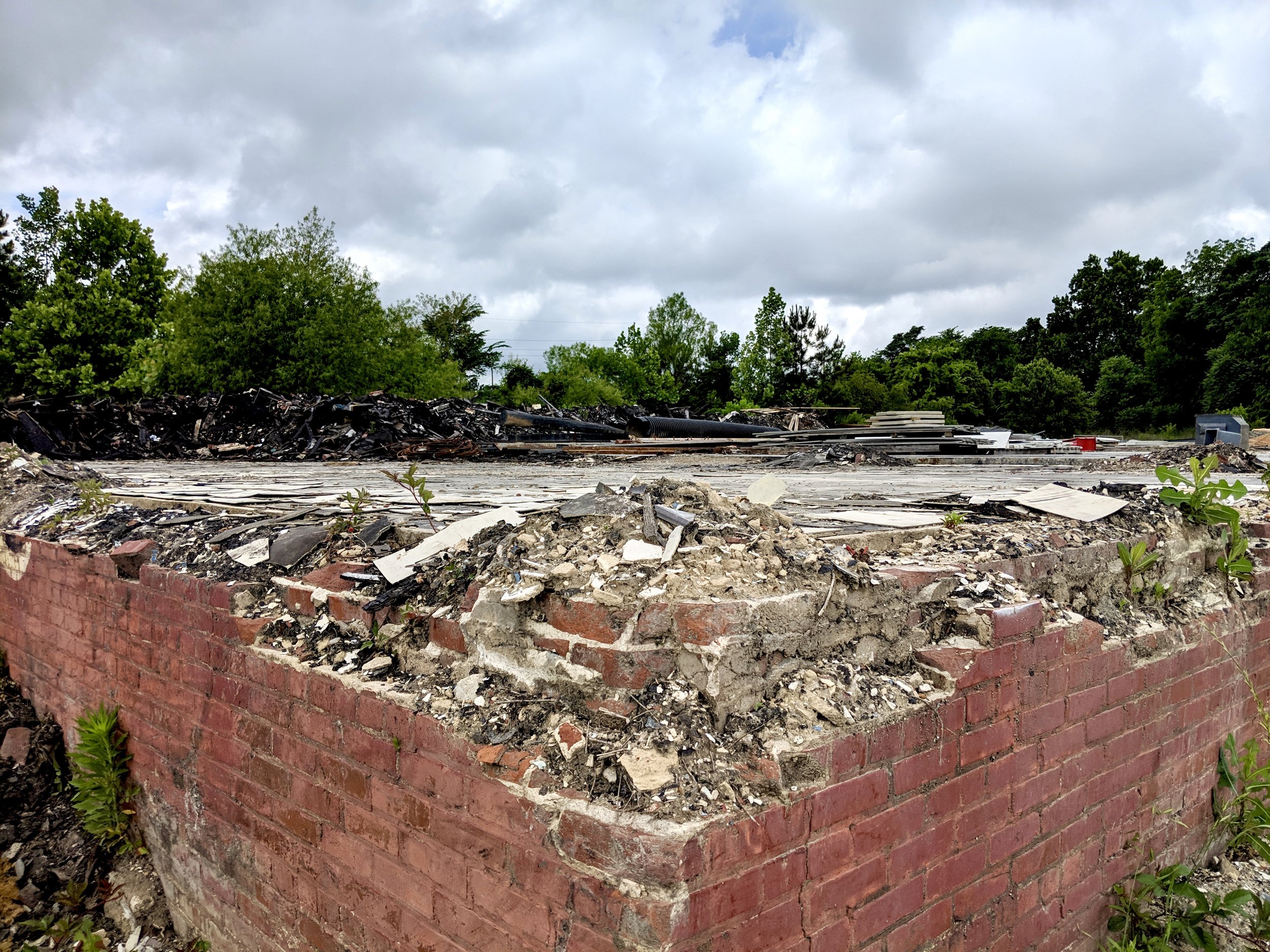
Under the banner of urban renewal, the neighborhood was deconstructed during the 1960s, displacing its residents throughout Macon. Considering the buses didn’t run to Tybee, this often meant that Tybee residents were losing their homes and their jobs. Cycling through the area last week, I saw neglected structures, skeleton foundations that had clearly suffered a fire, empty fields, and a single house on Elm Street. If you don’t know about Tybee, you would never suspect this had once been the lands of a thriving community.    

Often times, preservation is strictly thought of in terms of brick and mortar. But what about when the buildings are gone?  As we began planning Preservation Month activities for this year, it was clear to me something should be done to highlight the hidden history of Tybee. A history that is at risk of being lost from Macon’s memory. Though only one lone house remains from Tybee, the stories endure. Stories of commerce and kinship and craft. Stories of family and loss and fear. Stories worth preserving. Stories worth hearing. Stories worth sharing.

fullsizeoutput_1315.jpeg

We can all be a part of expanding Macon’s narrative. We can all be keepers of this history. By listening to the stories of those from Tybee, you become a part of preservation.

If you want to learn more about Tybee and what once was, join us this Preservation Month for Wrong Side of the Tracks: Panel on Macon’s Tybee Neighborhood. The panel consists of former residents, individuals connected to the community, and historians.

Click here for a live recording of the panel that took place in 2019.

Wrong Side of the Tracks

Panel on Macon’s Tybee Neighborhood

May 19

5:00 - 7:00 pm

Elaine Lucas Senior Center

132 Willie Smokie Glover Dr